Religious Charter Schools
A New Ruling in Oklahoma and DOJ's Changing View of the Federal Charter Schools Program
Ongoing Litigation over a Religious Charter School in Oklahoma
On September 24, 2026, in National Ben Gamla Jewish Charter School Foundation, Inc. v. Shellem, the U.S. District Court for the Western District of Oklahoma preliminarily enjoined the Oklahoma Statewide Charter School Board from excluding Ben Gamla from the state's charter school program because of its religious character. Although Oklahoma law defines charter schools as public schools supported by taxation, the court concluded that the proposed independently operated school would not be a governmental entity or state actor for First Amendment purposes. Relying on Carson v. Makin, the court found that excluding the applicant likely violates the Free Exercise Clause and that neutrally including it likely would not violate the Establishment Clause.
That analysis conflicts with the Oklahoma Supreme Court's 2024 decision in the St. Isidore litigation. An equally divided U.S. Supreme Court (4–4, with Justice Barrett recused) affirmed that decision in 2025 in Oklahoma Statewide Charter School Board v. Drummond, without creating precedent. Ben Gamla gives the issue another possible path back to the Court. The board did not oppose the injunction; intervening taxpayers and charter school families did. The injunction does not grant a charter or resolve the merits, and it does not address eligibility for federal education funding.
Note on the Federal Charter Schools Program
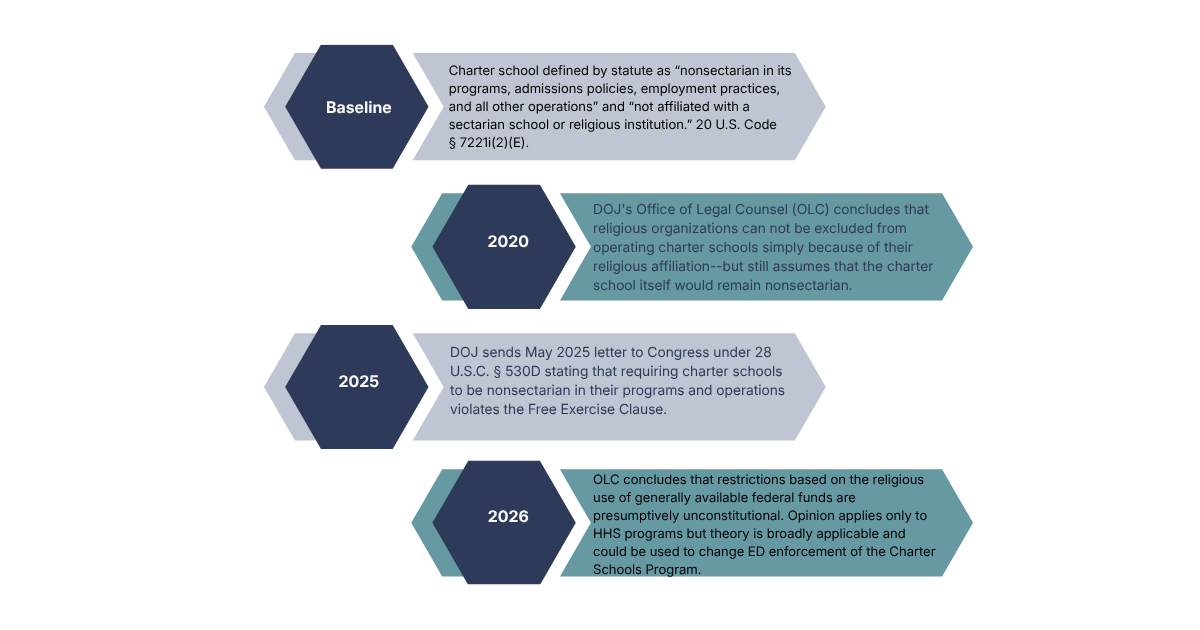
So far, the federal Charter Schools Program (CSP) is unchanged. The CSP statute expressly defines a charter school as a public school and requires it to be "nonsectarian in its programs, admissions policies, employment practices, and all other operations" and "not affiliated with a sectarian school or religious institution."
The U.S. Department of Justice (DOJ) has said that significant parts of these requirements are unconstitutional. At the same time, the U.S. Department of Education (ED) continues to award CSP funds, and its publicly posted guidance still says that charter schools must be nonreligious, that their curricula must be secular, and that public funds may not support religious programs or activities.
DOJ's position has shifted over time. In a 2020 opinion, DOJ's Office of Legal Counsel (OLC) concluded that religious organizations could not be excluded from operating charter schools simply because of their religious affiliation, but it still assumed that the charter school itself would remain nonsectarian.
Then, in a May 2025 letter to Congress under 28 U.S.C. § 530D, DOJ went further. It said that requiring charter schools to be nonsectarian in their programs and operations violates the Free Exercise Clause and that the employment requirement is subject to the ministerial exception. DOJ continued to defend the requirement that admissions policies be nonsectarian.
In August 2026, OLC broadened its Free Exercise theory again, this time in the context of programs operated by the U.S. Department of Health and Human Services (HHS) rather than charter schools. In Constitutionality of Religious Restrictions on the Use of Federal Funds, OLC concluded that restrictions based on the religious use of generally available federal funds are presumptively unconstitutional. The opinion addressed HHS, but its reasoning is broad enough to have implications for other federal funding programs.
This is a key area to watch. Federal agencies, including ED, can conclude that a particular statutory requirements is unconstitutional, and, after notifying Congress, can decline to enforce it.