Events


 The IDEA at 50: Preparing States for the Next Era of Federal Policy
Feb
18

The IDEA at 50: Preparing States for the Next Era of Federal Policy

Presented by National Association of State Directors of Special Education and Sligo Law Group, PLLC

With the Individuals with Disabilities Education Act turning 50, states find themselves at a pivotal moment. Long-standing statutory frameworks remain in place, but shifting federal priorities, funding mechanisms, and oversight practices are reshaping how the IDEA is implemented, financed, and enforced.

This webinar will provide a grounded, practical overview of the IDEA’s framework, focusing on state-level expectations, responsibilities, and areas of discretion, before turning to federal developments that are redefining the landscape. Participants will receive timely updates on federal appropriations, interagency agreements, and emerging policy signals that affect programmatic and fiscal decision-making.

We will also explore critical fiscal considerations for states, including changes to funding streams, strategies for protecting IDEA funds, compliance and audit risk, and the transition to new or evolving federal grants systems. Speakers will highlight common pitfalls, enforcement trends, and lessons learned from recent federal and state activity. The session will conclude with concrete best practices and actionable take-aways to help states strengthen compliance, safeguard funding, and position themselves for the next era of federal special education policy.

Slides and supporting materials will be shared after the webinar.

Speakers:

  • Audrey Levorse, Deputy Executive Director, NASDSE

  • Becca Walawender, Senior Advisor, Sligo Law Group

  • Chris Brown, CFO for the Arizona Department of Education

  • Emily Merolli, Partner, Sligo Law Group

  • Marcus Hedrick, Of Counsel, Sligo Law Group

This event is free, but registration is required.

View Event →
Brace for Impact: Federal Education Policy in the New Year
Jan
15

Brace for Impact: Federal Education Policy in the New Year

2025 was a turbulent year in education. From foundational policy shifts to abrupt changes in federal grants and civil rights enforcement, long-standing norms were tested—and districts, states, institutions, and partners were often left navigating uncertainty in real time. As the new year begins, clarity may still be elusive—but patterns are emerging.

Join us and our federal education law and policy “besties” for a candid, fast-paced conversation about what to watch in the months ahead.

We’ll dig into:

  • The Department of Education’s interagency agreements and ongoing efforts to dismantle the agency

  • K–12 policy trends and federal grants

  • Civil rights issues and enforcement

  • IDEA developments

  • New federal student loan limits

  • Higher education accountability and accreditation changes

  • What’s ahead on Capitol Hill and at the Supreme Court

More details coming soon! This event is free, but registration is required.

View Event →
Section 117 of the Higher Education Act: Basics of Foreign Gift and Contract Reporting for Institutions of Higher Education
Jan
7

Section 117 of the Higher Education Act: Basics of Foreign Gift and Contract Reporting for Institutions of Higher Education

Join us for a free 60-minute webinar on Section 117 of the Higher Education Act: Basics of Foreign Gift and Contract Reporting for Institutions of Higher Education. This session will provide an overview of requirements for reporting foreign gifts and contracts under Section 117 of the Higher Education Act. With the semiannual reporting deadline approaching and heightened administration focus on compliance by institutions of higher education (IHEs) in a range of areas, this webinar is intended to assist IHEs in understanding the basics of Section 117 reporting, as well as how to comply with some of the more nuanced aspects of the statute’s requirements.

The webinar will address the following:

  • Definition of “foreign source” 

  • Reporting of gifts

  • Reporting of contracts

  • Restricted and conditional gifts and contracts

  • Avoiding possible underreporting

  • Importance of Section 117 policies and procedures

The session will be led by Lisa Wells Harris, Of Counsel at Sligo Law Group. Lisa coordinated a team of attorneys working to collaboratively resolve investigations into the reporting of foreign gifts and contracts under Section 117 while serving in the U.S. Department of Education’s Office of General Counsel.

View Event →
Equitable Services 101: Foundations for Serving All Students under the ESEA
Nov
18

Equitable Services 101: Foundations for Serving All Students under the ESEA

Join us for a free 60-minute webinar on Equitable Services 101: Foundations for Serving All Students under the ESEA. Learn the nuts and bolts of providing equitable services under Title I, Part A (Title I) and Title VIII of the Elementary and Secondary Education Act of 1965 (ESEA).

This free 60-minute webinar will provide an overview of requirements for providing equitable services to eligible private school students, educators, and families under ESEA programs, including:

  • Timely and meaningful consultation between public and private school officials

  • Allocations and other fiscal considerations

  • Delivery of equitable services

  • Monitoring and enforcement

The session will be led by Josie Eskow Skinner and Michael Anderson, who advised on these matters while serving in the U.S. Department of Education’s Office of the General Counsel.

Sligo Law Group also will be offering an Equitable Services Institute in early 2026 that will provide a more robust, in-depth exploration of each of these topics. Details are coming soon!
Register here

View Event →
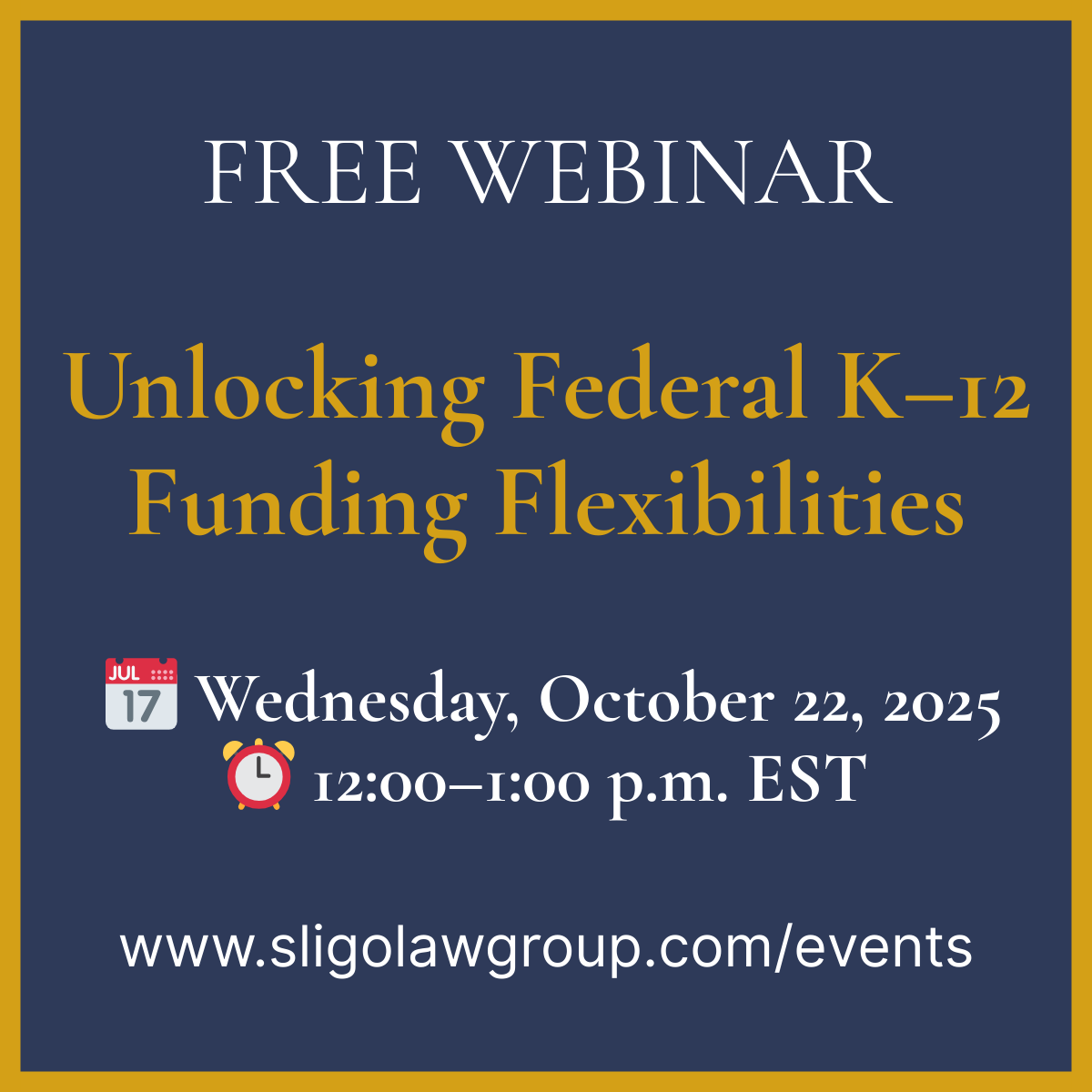
Unlocking Federal K–12 Funding Flexibilities
Oct
22

Unlocking Federal K–12 Funding Flexibilities

Join us for a free 60-minute webinar on Unlocking Federal K–12 Funding Flexibilities. Learn how to maximize funding flexibilities in federal K–12 programs as your program needs continue to evolve. 

This free 60-minute webinar will highlight a range of flexibilities available to states, districts, and schools, including:

  • ESEA waivers of statutory and regulatory requirements

  • Transferability authority across Titles I–IV of the ESEA

  • Consolidation of federal, state, and local funds in a Title I schoolwide program

  • Ed-Flex authority under the Educational Flexibility Partnership Act

The session will be led by Josie Eskow Skinner and Michael Anderson, who advised on these matters while serving in the U.S. Department of Education’s Office of the General Counsel.
View Event →
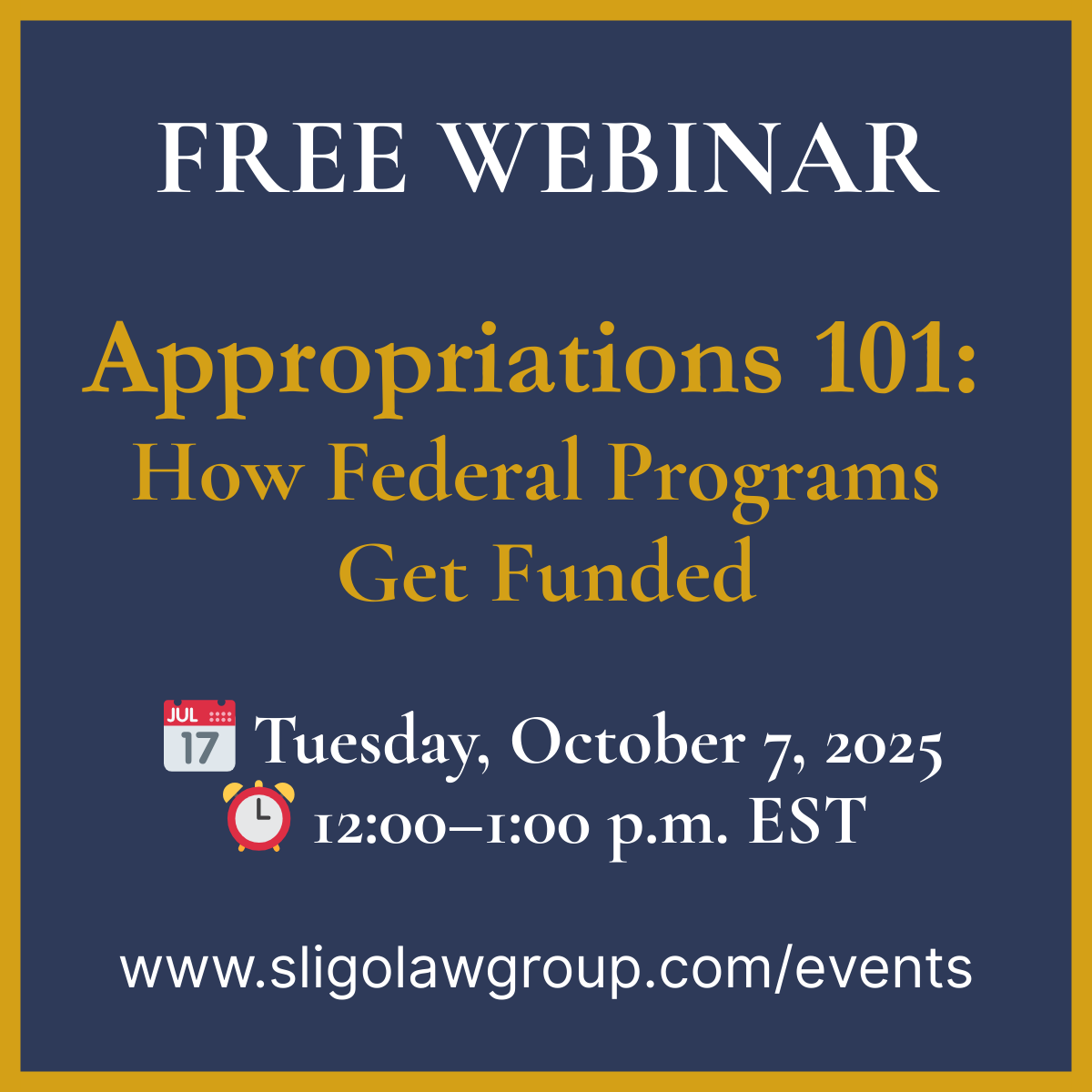
Appropriations 101: How Federal Programs Get Funded
Oct
7

Appropriations 101: How Federal Programs Get Funded

Join us for a free 60-minute webinar on Appropriations 101: How Federal Programs Get Funded.

Congress’s appropriations process determines how much funding federal programs—from education and health to housing, defense, and beyond—receive each year. Yet the appropriations process and law are often misunderstood, even by experienced grant recipients and policymakers.

This webinar will break down the essentials of appropriations law, including:

  • “Authorizations” v. “Appropriations” – how they differ and why that matters for your programs

  • The 12 annual appropriations bills and how they fund agencies across government

  • Key terms like “mandatory” vs. “discretionary” spending, continuing resolutions, and omnibus bills

  • How appropriations riders and general provisions shape program implementation

This session will be led by Paul Riddle, a Senior Advisor with Sligo Law Group. Paul served the U.S. Department of Education for 47 years, including 20 years as the Assistant General Counsel for Legislation, before retiring in January 2025. While at ED, he supervised the drafting and analysis of legislation for the full range of ED’s programs and interests and worked closely with both political and career staff in all ED offices, the White House (including the Office of Management and Budget), and congressional staff.

This session is designed for a broad audience: state and local officials, nonprofits, higher education institutions, policy professionals, and organizations that rely on federal funding.

View Event →